
Autism Spectrum Disorder: Signs, Levels, Diagnosis & Treatment Explained
A mother once described the first time she wondered about her son. He was nearly two. He repeatedly put up his toy cars in a precise order before hardly looking up when mom called his name. He was obviously bright. He just seemed to live a little differently than the other children. That silent, nagging question: is this just his personality, or something more? Many families’ journeys with autism spectrum disorder begin here.
If you are asking similar questions, you are not alone, and you are not overreacting. Autism spectrum disorder is one of the most common neurodevelopmental conditions in the world, and understanding it early can change a child’s whole trajectory. This guide walks through what ASD actually is, the different types of autism and the levels of autism, the signs to watch for at every age, how diagnosis works, and what realistic, evidence-based support looks like.
What Is Autism Spectrum Disorder?
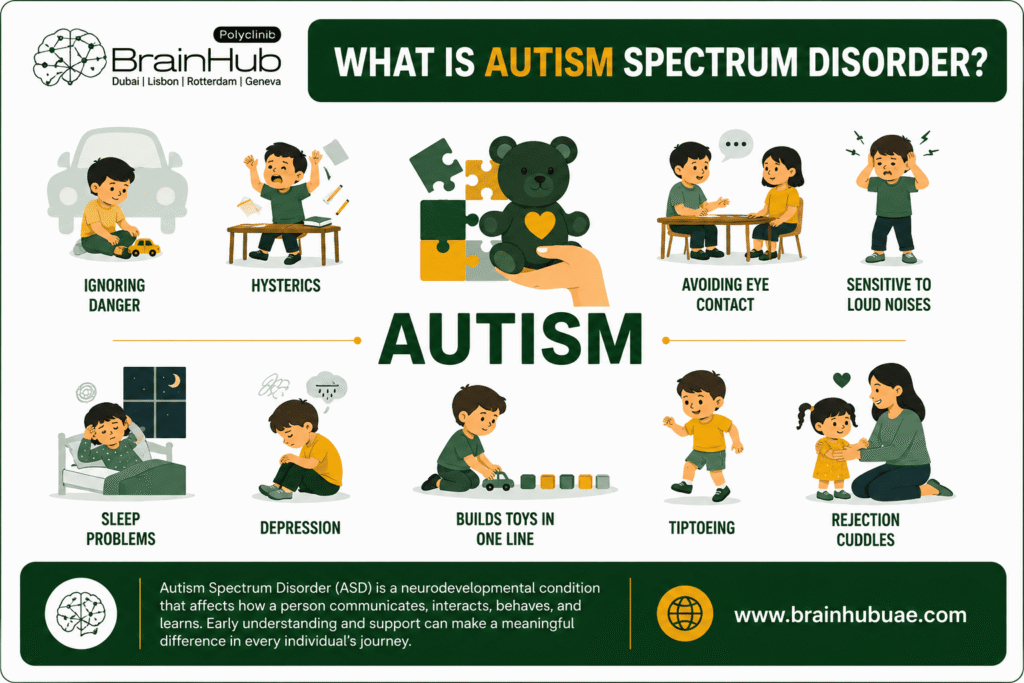
Autism spectrum disorder is a neurodevelopmental condition that affects how a person communicates, interacts socially, processes information, and experiences the world around them. The word spectrum matters here. Autism is not a single, uniform condition with one fixed presentation. It is a wide range of strengths, challenges, and traits that look remarkably different from one person to the next.
Two autistic children can sit in the same classroom and seem like complete opposites. One might be nonverbal and need substantial daily support; another might be academically gifted, deeply verbal, and quietly overwhelmed by the noise of the cafeteria. Both are autistic. That variability is exactly why clinicians moved away from older, separate labels and adopted the single umbrella of “spectrum.”
Autism is lifelong. It is not an illness to be cured, and it is not caused by anything a parent did or failed to do. It is a different way the brain is wired, one that comes with genuine difficulties for many people, and also, frequently, with real gifts: pattern recognition, honesty, focus, creativity, and loyalty among them.
Understanding the Levels of Autism
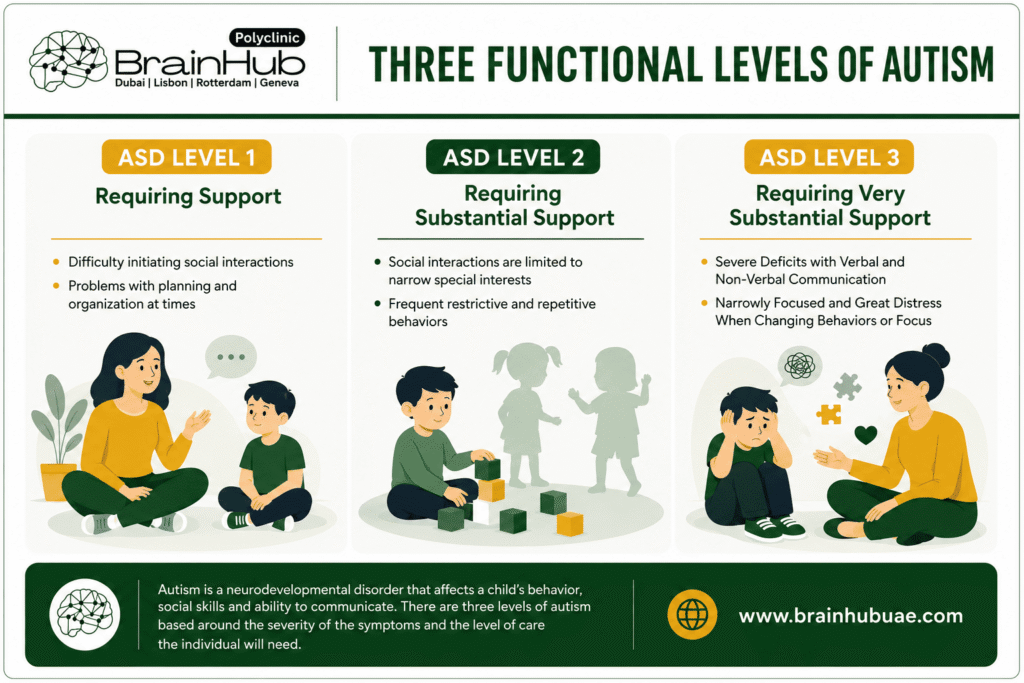
When people ask about the different types of autism, they are usually pointing toward something the current diagnostic manual describes as the levels of autism. Rather than separate diagnoses, autism is now understood along a continuum of support needs. Knowing the autism spectrum levels helps families and clinicians describe how much day-to-day help a person actually needs.
Level 1 – Requiring support. This is often what people mean when they talk about a mild autism symptom or “high-functioning” autism. A person at Level 1 can usually speak in full sentences and manage many parts of independent life, but struggles with back-and-forth conversation, reading social cues, switching between activities, and organising tasks. What does mild autism look like in practice? It can look like a child who has very specific interests, takes language literally, prefers routine, and finds friendships confusing rather than effortless.
Level 2 – Requiring substantial support. Autism level 2 symptoms include more noticeable difficulties with verbal and nonverbal communication, more limited or unusual social initiation, and repetitive behaviours that are obvious even to a casual observer. Changes to routine cause real distress. Speech may be present but markedly affected, and the person needs consistent support across settings.
Level 3 – Requiring very substantial support. Communication is quite difficult at this level. The person may need a lot of assistance with everyday tasks and safety, speak little or not at all, and find any change to be very upsetting. The demand for assistance is intense and ongoing.
It is worth saying plainly that these levels are not rigid boxes, and they can shift over time. The same person may need more support in one area and less in another. A child described at Level 2 in early childhood may, with the right intervention, move toward greater independence. The levels of autism are a snapshot of support needs, not a ceiling on a person’s potential.
Related Blogs
What Causes Autism? Genetics, Pregnancy, and the Honest Science
One of the first questions almost every parent asks is some version of “why?” Often it comes out as is autism hereditary, or does autism run in families. The honest answer is that autism has a strong genetic component, but no single cause.
Research consistently shows that genetics play a major role. So when families ask whether autism runs in families, the evidence says yes, it frequently does, having one autistic child raises the likelihood of another being autistic, and autism is more common among close relatives. Many different genes appear to be involved, sometimes inherited and sometimes arising as new changes. This is why the question is autism hereditary doesn’t have a tidy yes-or-no answer: there is a clear hereditary pattern, but inheritance alone does not fully explain it.
The science suggests factors including advanced parental age, specific pregnancy and birth problems, extreme preterm, and particular maternal health disorders as causes of autism during pregnancy. These increase the risk somewhat, but they do not cause autism on their own, and the majority of births including these factors do not result in an autistic kid. It’s also critical to dispel a common misconception: immunizations don’t cause autism. This connection has been thoroughly examined and conclusively refuted.
So if you are searching what causes autism during pregnancy out of guilt, please set that burden down. There is no diet, no single decision, and no parenting style that creates autism. It is a complex interaction of genetics and biology that begins before a child is born.
Signs of Autism by Age
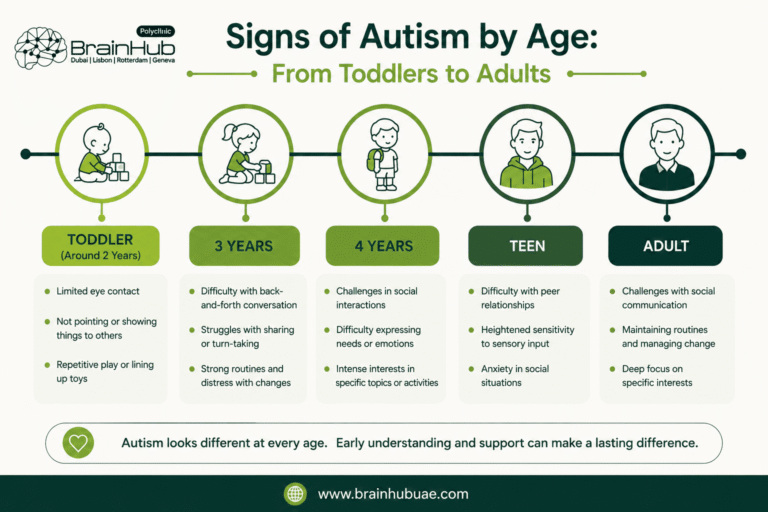
Because autism shows up differently as children grow, it helps to look at the signs by developmental stage rather than as one fixed list. Early recognition genuinely matters, the earlier support begins, the better the outcomes tend to be.
Early Signs of Autism in Toddlers (12–24 Months)
The early signs of autism in toddlers usually involve social communication. Parents looking for signs of autism in toddlers often notice:
- Limited or fleeting eye contact
- Little or no response to their own name
- Few gestures, such as pointing or waving
- Not sharing attention – for example, not looking back at a parent to “show” them something exciting
- Delayed babbling or first words
When parents specifically ask about signs of autism in a 2 year old, common red flags include:
- Not using single words by 16 months
- Loss of words or skills the child previously had
- Limited or absent pretend play
- Strong reactions to certain sounds or textures
- A preference for playing alone
Repetitive movements often emerge here too, which is where one very common question fits: is spinning a sign of autism? Spinning objects, spinning themselves, hand-flapping, or rocking can all be repetitive behaviours associated with autism, but spinning on its own, especially briefly and playfully, is also normal toddler behaviour. It becomes meaningful when it is intense, frequent, and paired with the other signs of autism in 2 year old children listed above. For a deeper look, see our companion article on the early signs of autism in toddlers and the red flags worth watching for.
Signs of Autism in 3 Year Olds and 4 Year Olds
By the preschool years, the picture often becomes clearer. Signs of autism in 3 year olds frequently center on language and social play:
- Delayed or unusual speech patterns
- Repeating phrases or words (echolalia)
- Difficulty with simple back-and-forth conversation
- Trouble playing alongside peers
- Intense distress when routines change
Signs of autism in 4 year old children build on this. At this stage you may notice:
- Fluent speech, but mostly focused on a single fascinating topic
- Difficulty reading facial expressions or taking turns
- Lining up or sorting objects with great precision
- Meltdowns when the day doesn’t go as expected
- Sensory sensitivities – to clothing tags, food textures, bright lights, or loud places
Signs of Autism in Teens
Autism doesn’t disappear with age; it simply changes shape. The signs of autism in teens often look like:
- Social exhaustion after time with peers
- Difficulty with the unwritten rules of friendships
- Strong reliance on routine and predictability
- Deep, specialised interests
- Feeling out of step with peers, often alongside anxiety or low mood
Some teenagers are diagnosed for the first time here, especially if they coped well academically earlier. Much of this anxiety comes from years of trying to “fit in.”
It is essential to talk about autism in teenage girls separately. Autistic girls are frequently missed because they mask – they study and imitate social behaviour, hold themselves together at school, and then unravel at home. In girls, the signs of autism in teens can therefore be quieter:
- Intense but socially “acceptable” interests
- A small number of close friendships that still feel effortful
- Perfectionism
- Significant internal anxiety that others rarely see
This masking is a major reason autism in teenage girls is under-diagnosed for years.
Autistic Traits in Adults
Many people only recognise themselves once their own child is assessed. Autistic traits in adults can include:
- Lifelong difficulty with social situations
- A strong need for routine and predictability
- Sensory sensitivities
- Deep focus on specific interests
- Exhaustion after socialising
Adults with autism frequently experience comfort rather than distress when their features are identified; it provides a long-needed explanation for previously inexplicable experiences.
Also Read- Autism Tantrum vs Meltdown: What’s the Difference?
When Should You Seek Care?
You do not need to wait for certainty before asking for help. If your child is missing communication milestones, losing skills they once had, or showing several of the signs above, that is reason enough to seek an evaluation. The same applies to teenagers and adults who recognise persistent social and sensory challenges that affect daily life.
A useful principle: trust early concern over reassurance. “Let’s wait and see” can quietly cost a child months of valuable early support. At BrainHub Polyclinic in the UAE, families are encouraged to book a developmental assessment when concerns first appear rather than after they have grown — because intervention works best when it starts early. If you are unsure whether your worries justify a formal review, our guidance on when to seek an autism evaluation for your child can help you decide.
How Autism Is Diagnosed?
There is no blood test or brain scan that diagnoses autism. Diagnosis is a careful, structured clinical process carried out by professionals such as developmental paediatricians, child psychologists, and psychiatrists, usually working as a team.
A thorough examination is usually conducted after developmental screening using instruments such as the M-CHAT questionnaire for toddlers. In addition to a thorough developmental history from parents, direct observation of the child, and feedback from educators or other caregivers, this evaluation makes use of standardized, globally recognized instruments, the most popular of which is the ADOS-2. Additionally, clinicians rule out or identify illnesses including ADHD, anxiety, language difficulties, and impairments in sensory processing that are frequently associated with autism.
A full examination requires multiple appointments. It is a layered picture created from multiple perspectives, which is precisely what makes it reliable. Our comprehensive explanation of how autism is diagnosed describes each step of the evaluation process in clear language.
Treatment and Support: What Actually Helps?
This brings us to a question families ask with real urgency: is autism curable? The clear, honest answer is no, autism is not a disease and there is no cure, and any product or program promising to “cure autism” should be treated with deep suspicion. But this is not the discouraging news it might first sound like. Autism does not need to be cured to be supported, and the right support can transform quality of life.
There is no surgery for autism and no single medication that treats it. Instead, evidence-based support is built around therapies tailored to the individual. These commonly include behavioural and developmental therapies, speech and language therapy to support communication, occupational therapy for daily living and sensory needs, and social skills support. Medication is sometimes used, not for autism itself, but to help with co-occurring issues like significant anxiety, attention difficulties, or sleep problems.
Formal therapy is important, but so is understanding how to deal with autistic children on a daily basis. A tranquil sensory environment, visual aids, clear and specific communication, predictable routines, and early notice before transitions are all very beneficial. Knowing what not to do with an autistic child is equally crucial: avoid punishing stimming (the self-soothing repetitive motions like rocking or hand flapping), avoid making eye contact, avoid overstimulating the child with abrupt changes, and never make fun of their differences. Supporting a child to flourish as themselves has the opposite effect of pressuring them to repress who they are.
A reasonable, balanced expectation is this: support helps, often dramatically, but it is not a race toward “normal.” The goal is a child, and later an adult, who can communicate, cope, and live a meaningful life. If you are weighing your options, our overview of autism treatment options and which therapy may be right for your child compares the main evidence-based approaches.
Risks, Limitations, and Honest Expectations
There are boundaries to every therapy, and being truthful is essential to providing quality care. Seldom is progress linear. The same strategy may have rather varied effects on two kids with comparable profiles. Not every program offered for autism is supported by strong data; some are unsuccessful, some are actually harmful, and other interventions are intensive and demanding for families.
Beware of anything that guarantees results, promises a cure, or claims to “recover” a child from autism. Reputable clinicians set realistic goals, measure progress carefully, and adjust the plan as your child grows. The aim is steady, individualised gains, not a fixed timeline or a finished destination.
Living With Autism: Long-Term Outcomes
What does life really look like throughout time?
With awareness and support, the long-term picture for autistic persons is significantly more promising than previous, bleaker tales implied. Many autistic individuals pursue employment, relationships, and independent living. Others require continued help throughout their lives, which is also a valid and dignified conclusion.
People frequently wonder what goes on in the minds of people with autism. Although each person is different, many people with autism describe thinking in vivid detail, seeing patterns that others overlook, experiencing strong emotions, and finding great solace and delight in their passions. It might be exhausting to translate the rich inner world into a neurotypical social setting.
A related question is whether do autistic people know they are autistic. Younger children often do not have that self-awareness, but many older children, teens, and especially adults understand themselves very well, sometimes long before they receive a formal diagnosis. For many, finally having a name for their experience is profoundly validating.
Can Autism Be Prevented?
Because the causes are largely genetic, there is no reliable way to prevent autism, and parents searching how to prevent autism deserve a straight answer rather than false hope. You cannot prevent a child from being autistic through diet, supplements, parenting choices, or avoiding vaccines. What you can do is support healthy pregnancy through good prenatal care, and, far more importantly, recognise the signs early so support can begin as soon as possible. In autism, the most powerful lever is not prevention; it is early identification and the right help.
What to Expect During Your Consultation?
Instead of seeming like an interrogation, a first consultation should feel like the beginning of a collaboration. Anticipate discussing your child’s developmental history, your particular worries, and instances of behavior you have observed. The doctor will watch and engage with your kid, inquire about developmental milestones, and provide a comprehensive explanation of the evaluation procedures. You ought to depart knowing what will happen next.
A good clinician will also help you explain things to your child and family in an age-appropriate way. Parents often ask how to explain autism to kids, both their autistic child and their siblings. The honest, kind framing works best: everyone’s brain works a little differently, and autism means your brain handles some things, like noise or change or making friends, in its own way, with its own strengths. Knowing how to explain autism to kids without shame helps the whole family.
At BrainHub Polyclinic, assessments are designed to be unhurried and family-centred, so you leave with clarity rather than more questions.
Book an Autism Assessment at BrainHub Polyclinic
If something in this guide resonated with you, the next step does not have to be overwhelming. BrainHub Polyclinic in the Dubai offers compassionate, family-centred developmental and autism assessments led by an experienced multidisciplinary team, developmental specialists, psychologists, and therapists working together under one roof.
What you can expect when you reach out to us:
- Unhurried, expert evaluation using internationally recognised assessment tools
- Clear answers, in plain language – you leave understanding your child, not with more questions
- A personalised support plan spanning speech therapy, occupational therapy, behavioural support, and social skills
- Care for the whole family, including guidance on how to explain autism to kids and support siblings
- Support across every age – from early signs of autism in toddlers to assessments for teens and adults
Early support changes outcomes. Whether you are noticing the first signs of autism in toddlers or seeking clarity for an older child, teenager, or yourself, our team is here to help.
BrainHub Polyclinic, UAE – Book a consultation or call our clinic today to schedule a developmental assessment.
Faqs
Limited eye contact, trouble having back-and-forth conversations, repetitive motions like hand flapping or spinning, intense concentration on particular hobbies, a strong connection to routine, and increased sensitivity to sounds, lights, or textures are typical symptoms. Any one of them can serve as an example of an ASD symptom if it is persistent and part of a larger pattern.
Yes, autism has a strong genetic component, and it does tend to run in families. Having one autistic relative increases the likelihood for others. However, genetics interact with other biological factors, so heredity is a major influence rather than the only one.
No. Autism is a lifelong neurodevelopmental difference, not a disease, so it cannot be cured. The right therapies and support can, however, dramatically improve communication, coping, and quality of life. Be wary of anyone claiming a cure.
There is no single prenatal cause. Factors such as advanced parental age, certain pregnancy or birth complications, and extreme prematurity can slightly raise the likelihood, but they do not directly cause autism. Vaccines do not cause autism.
Spinning can be a repetitive behaviour linked to autism, but on its own it is also normal play. It becomes meaningful when it is intense, frequent, and combined with other signs such as limited communication or strong sensory reactions.
Often described as Level 1, a mild autism symptom profile may include fluent speech, strong specific interests, literal thinking, a preference for routine, and difficulty reading social cues, alongside clear strengths and the ability to manage much of daily life independently.
Autism level 2 symptoms involve substantial support needs: more noticeable communication difficulties, limited social initiation, obvious repetitive behaviours, and significant distress with change.
The early signs of autism in toddlers include not responding to their name, limited eye contact, few gestures like pointing, delayed speech, limited pretend play, and repetitive movements. These are the same red flags many parents notice when looking for signs of autism in toddlers.
Knowing how to deal with autistic children starts with predictable routines, clear and concrete language, visual supports, advance warning before transitions, and a calm sensory environment, and meeting the child where they are rather than forcing typical behaviour.
Key things to avoid: do not punish stimming, do not force eye contact, do not impose sudden unexplained change, and never treat their differences as shameful. Knowing what not to do with an autistic child protects their wellbeing and trust.
Many do, especially adults, teens, and older kids. Although many people find peace and clarity when they realize they have autism, young children frequently lack this self-awareness.
Every autistic mind is different, but many describe detailed thinking, strong pattern recognition, intense emotions, and deep engagement with their interests. Understanding what goes on in an autistic mind helps families support rather than misjudge their loved one.
The simplest explanation is the most effective: autism causes some things, such noise, change, or socializing, to feel different in addition to actual strengths since every person’s brain functions differently. Both autistic youngsters and their siblings benefit from learning how to explain autism to children without feeling ashamed.
Yes. The signs of autism in teens often appear as social exhaustion, reliance on routine, deep interests, and anxiety. In autism in teenage girls especially, masking can hide the signs, which is why many girls are diagnosed late.
The traits are present throughout life, but recognising autistic traits in adults often happens later, frequently after a child’s diagnosis prompts self-reflection.
About BrainHub Polyclinic
Written by BrainHub Editorial Team | Medically Reviewed by Department Specialists
Established Specialist Neurology Hub
Dedicated Expert Clinicians & Multi-Disciplinary Care Teams
Advanced Neuro-Diagnostic & Therapeutic Infrastructure
Patient-Centric Treatment Plans Built for Long-Term Quality of Life
BrainHub Polyclinic is a leading multi-specialty healthcare institution committed to delivering world-class, tech-integrated neurological care and rehabilitation.
Featuring a highly collaborative network of experienced specialists across dedicated medical and rehabilitative fields, the clinic enforces rigorous, evidence-based treatment protocols to maximize patient safety and clinical outcomes.
Our clinical teams specialize in addressing complex conditions, providing tailored neuromodulation programs, pediatric development therapies, and modern intervention paths for epilepsy management.
Our specialized healthcare content is thoroughly drafted and systematically reviewed by qualified medical professionals and neurological department specialists to maintain structural accuracy, complete data reliability, and helpful clinical transparency.
Equipped with advanced medical infrastructure and an unwavering focus on a patient-centric approach, BrainHub Polyclinic remains a trusted regional hub for comprehensive modern medicine and restorative care.
Medical Disclaimer
The content on this page is provided for informational purposes only and does not constitute medical advice, diagnosis, or treatment. Always consult a qualified healthcare professional for personalized medical guidance.
Medically reviewed by the Neurological Specialty Department