
Vagus Nerve Stimulation (VNS) Therapy: How It Helps Children and Adults
Living with epilepsy or seizures that do not respond adequately to medication can significantly impact daily life for both children and adults. When medications alone are not enough to control seizures, advanced treatment options such as vagus nerve stimulation may be recommended as part of a comprehensive long-term management strategy.
At BrainHub Polyclinic, specialists focus on modern neurological therapies such as VNS therapy to help improve quality of life for patients who struggle with uncontrolled seizures. This treatment works by focusing on the vagus nerve, offering a new way to manage brain activity and help lower the number of seizures over time.
What is Vagus Nerve Stimulation?
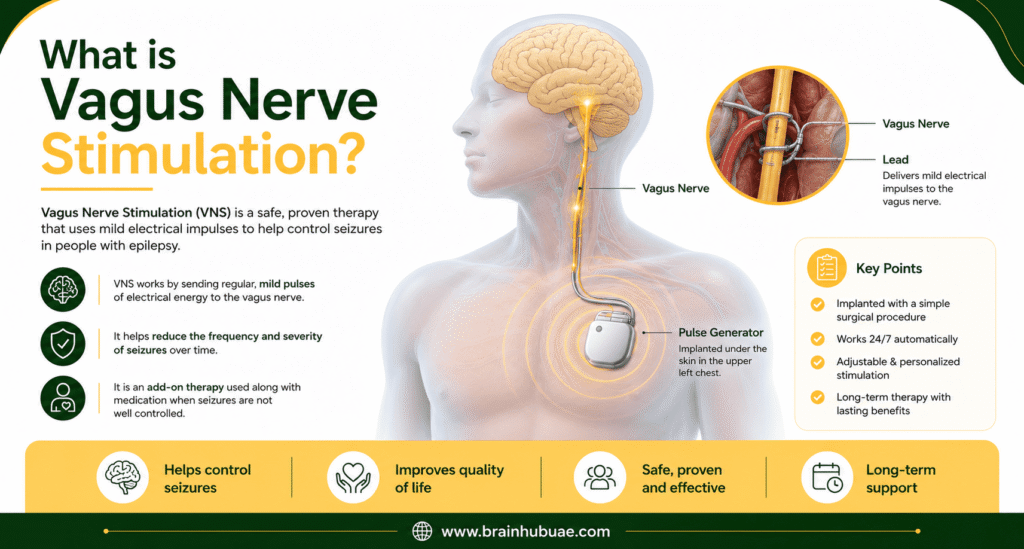
Vagus nerve stimulation (VNS therapy) is a medical treatment that involves delivering mild electrical impulses travel to the vagus nerve, a long nerve that runs from the brain all the way down to the abdomen.
These impulses are produced by a compact device placed under the skin, most commonly in the chest. The main goal of vagus nerve stimulation is to help control unusual electrical activity in the brain.
It is most commonly used for patients with epilepsy who do not respond well to anti-seizure medications.
So, what is vagus nerve stimulation in simple terms? It is a form of neuromodulation that helps “calm” irregular brain signals and reduce the intensity or frequency of seizures over time.
Does Vagus Nerve Stimulation Work?
A common question patients and families ask is: does vagus nerve stimulation work?
The answer is that results vary from person to person, but many patients experience meaningful improvement. While VNS therapy may not completely stop seizures, It can help lower how often these problems happen and make them less severe for both children and adults.
For some patients, improvements may also include:
- Shorter seizure duration
- Faster recovery after seizures
- Improved alertness and mood
- Better overall quality of life
This is why VNS therapy for epilepsy is often considered when medications alone are not enough.
VNS for Seizures: Who Can Benefit?
VNS for seizures is typically recommended for individuals with:
- Epilepsy that does not respond to standard medications
- Seizures that start in one area of the brain
- Generalised seizures that are hard to manage with treatment
- People who cannot have brain surgery as a treatment option
Both children and adults may benefit from vagus nerve stimulation benefits, especially when seizures significantly impact daily life, learning, or independence.
In paediatric cases, VNS therapy is often considered when seizures affect development, behaviour, or cognitive progress.
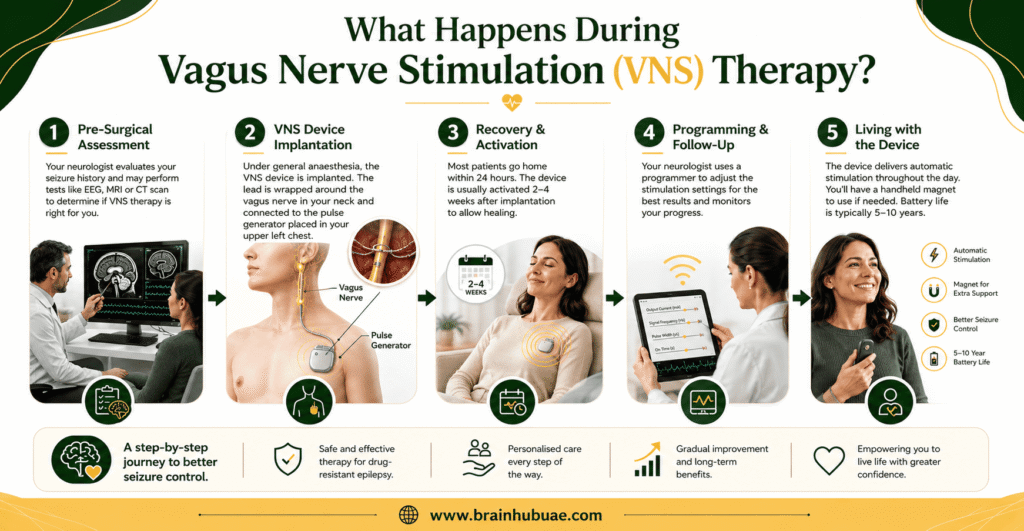
What Happens During Vagus Nerve Stimulation (VNS) Therapy?
Understanding the process can help patients and families feel more confident about vagus nerve stimulation and what to expect before, during, and after treatment.
Pre-Surgical Assessment
Before VNS therapy, a neurologist will assess whether the treatment is suitable through:
- Neurological assessment
- EEG test
- MRI or CT scan
- Check seizure history and past treatments
VNS Device Implantation
The vagus nerve stimulation procedure is performed under general anaesthesia and involves:
- Implanting a small pulse generator beneath the skin in the upper left chest
- Making a small incision in the neck to access the vagus nerve
- Connecting thin insulated wires from the vagus nerve to the pulse generator
Recovery and Activation
After surgery:
- Most patients return home within 24 hours
- VNS surgery takes approximately 1 to 2 hours to complete.
- The device is usually activated 2–4 weeks after implantation to allow for healing
Programming and Follow-Up
To optimise VNS therapy for epilepsy, neurologists will:
- Adjust stimulation frequency, intensity, and duration
- Monitor progress during follow-up visits
- Fine-tune settings to improve seizure control and minimise side effects
Living with the Device
Patients receiving VNS for seizures can expect:
- Automatic electrical stimulation throughout the day
- A handheld magnet to trigger additional stimulation if needed
- Gradual improvement and long-term vagus nerve stimulation benefits
- Battery life of approximately 5–10 years before replacement is required
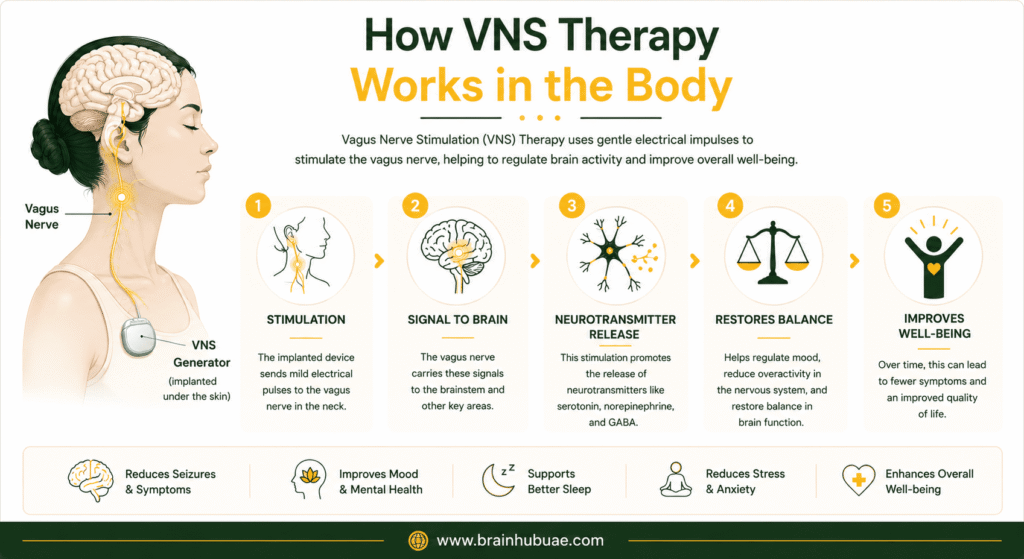
How VNS Therapy Works in the Body
The vagus nerve plays an important role in connecting the brain to several organs in the body. When stimulated, it sends signals that can influence brain activity and help reduce seizure triggers.
Over time, VNS therapy for epilepsy may help:
- Reduce seizure frequency
- Stabilise brain electrical activity
- Improve neurological function
- Support better emotional regulation
Unlike medications that work systemically, vagus nerve stimulation works through targeted nerve pathways, making it a unique and complementary treatment option.
What Does Vagus Nerve Stimulation Reduce?
One of the most important questions is: what does vagus nerve stimulation reduce?
Research and clinical experience show that VNS therapy may help reduce:
- Seizure frequency and intensity
- Post-seizure recovery time
- Seizure-related hospital visits
- Mood disturbances in some patients
Although results vary, many patients report a gradual improvement in seizure control over several months after starting therapy.
Benefits of VNS Therapy for Adults and Children
The vagus nerve stimulation benefits extend beyond seizure control alone. Many patients report improvements in overall well-being and daily functioning.
Key benefits include:
- Reduction in seizure frequency
- Improved quality of life
- Better cognitive clarity in some cases
- Non-drug-based therapy option
- Long-term treatment support
- Adjustable stimulation settings based on patient response
For adults, benefits VNS therapy for adults often include improved independence and reduced seizure-related anxiety. For children, it can support better school performance and developmental progress.
How Long Does VNS Surgery Take?
Another common concern is: how long does VNS surgery take?
The implantation procedure is generally considered a minimally invasive surgery and typically takes around 1 to 2 hours. The device is placed under the skin in the chest, and a thin wire connects it to the vagus nerve in the neck.
Most patients can return home within a short period after surgery, depending on their recovery and medical condition.
What to Expect After VNS Therapy
After implantation, the device is gradually programmed and adjusted over time. It does not deliver continuous stimulation at full strength; instead, it works in cycles throughout the day.
Patients may begin to notice changes in seizure patterns over several weeks to months. Regular follow-ups at BrainHub Polyclinic help ensure the device is optimally adjusted for the best possible outcome.
Possible Side Effects of VNS Therapy
Like any medical treatment, vagus nerve stimulation may have side effects. These are usually mild and may include:
- Hoarseness of voice
- Throat discomfort
- Mild coughing during stimulation
- Shortness of breath during activation
Most side effects reduce over time as the body adjusts to the therapy.
Why Choose BrainHub Polyclinic for VNS Therapy?
At BrainHub Polyclinic, neurological care is delivered with a patient-centred approach. Every case of epilepsy is unique, and treatment plans are tailored based on individual needs, medical history, and response to previous therapies.
- We offer thorough neurological evaluations to understand your needs.
- Our team provides advanced options for managing epilepsy.
- We create personalised VNS therapy plans tailored to each patient.
- We offer ongoing follow-up care and support for the long term.
This ensures patients receive structured care throughout their vagus nerve stimulation journey.
Take the Next Step Toward Better Seizure Control
If seizures continue to interfere with everyday life despite medication, vagus nerve stimulation therapy may provide an effective additional treatment option. At BrainHub Polyclinic, our neurological specialists take a personalised approach to care, carefully assessing each patient’s needs and creating tailored treatment plans aimed at improving seizure control, enhancing quality of life, and supporting better long-term outcomes.
Faqs
Vagus nerve stimulation, or VNS therapy, is mainly used to treat epilepsy in people who do not respond well to medication. It can help lower how often seizures happen and how severe they are.
While does vagus nerve stimulation work is a common question, results vary. Many patients experience fewer seizures, but outcomes depend on individual conditions and response.
The vagus nerve stimulation benefits include reduced seizures, improved recovery time, and better quality of life for both children and adults.
VNS for seizures uses a small device placed under the skin that sends signals to the vagus nerve. These signals can help control epileptic seizures.
The surgery to implant the device usually takes about 1 to 2 hours and is considered minimally invasive.
It can help reduce seizure frequency, severity, and recovery time in patients with epilepsy.
About BrainHub Polyclinic
Written by BrainHub Editorial Team | Medically Reviewed by Department Specialists
Established Specialist Neurology Hub
Dedicated Expert Clinicians & Multi-Disciplinary Care Teams
Advanced Neuro-Diagnostic & Therapeutic Infrastructure
Patient-Centric Treatment Plans Built for Long-Term Quality of Life
BrainHub Polyclinic is a leading multi-specialty healthcare institution committed to delivering world-class, tech-integrated neurological care and rehabilitation.
Featuring a highly collaborative network of experienced specialists across dedicated medical and rehabilitative fields, the clinic enforces rigorous, evidence-based treatment protocols to maximize patient safety and clinical outcomes.
Our clinical teams specialize in addressing complex conditions, providing tailored neuromodulation programs, pediatric development therapies, and modern intervention paths for epilepsy management.
Our specialized healthcare content is thoroughly drafted and systematically reviewed by qualified medical professionals and neurological department specialists to maintain structural accuracy, complete data reliability, and helpful clinical transparency.
Equipped with advanced medical infrastructure and an unwavering focus on a patient-centric approach, BrainHub Polyclinic remains a trusted regional hub for comprehensive modern medicine and restorative care.
Medical Disclaimer
The content on this page is provided for informational purposes only and does not constitute medical advice, diagnosis, or treatment. Always consult a qualified healthcare professional for personalized medical guidance.
Medically reviewed by the Neurological Specialty Department