
What Are The 4 Types of OCD And How to Spot The Signs
You checked the door once, twice, and then again. You know it’s locked, but your mind won’t let it go.
Maybe it’s not checking, maybe it’s a thought – something disturbing, unwanted, or completely unlike you – that keeps showing up even if you try to push it away.
If this feels familiar, you’re at the right place. This is how OCD behavior shows up in everyday life.
At BrainHub UAE, specialists understand that Obsessive-Compulsive Disorder isn’t just about habits; it’s about the distressing cycle of thoughts and behaviors that can quietly take over your day.
This guide will help you understand the types of OCD, recognize Obsessive Compulsive Disorder symptoms, and answer questions like “how do you know if you have OCD?” and “what kind of OCD do I have?”
What is OCD? Why does it feel so hard to stop?
To understand OCD, you first need clarity on what is OCD behaviour.
OCD operates in a cycle:
- Obsessions → unwanted, intrusive thoughts
- Compulsions → actions or mental rituals to reduce anxiety
Difference between obsession and compulsion
The difference between obsession and compulsion is simple but powerful:
Obsessions: “What if something bad happens?” | Compulsions: “I need to do something to prevent it.” |
Example – Obsession: Fear of contamination | Example- Compulsion: Repeated handwashing |
Here’s the challenge: compulsions may bring temporary relief, but they reinforce the cycle, making OCD behavior stronger over time.
Here’s something important: Is OCD common? It affects approximately 2-3% of people globally over their lifetime, that’s millions of people. And yet the average person waits 9 to 12 years before seeking treatment, often because of shame, misunderstanding, or simply not recognizing what they have. |
Let's talk about the 4 types of OCD and what they actually feel like
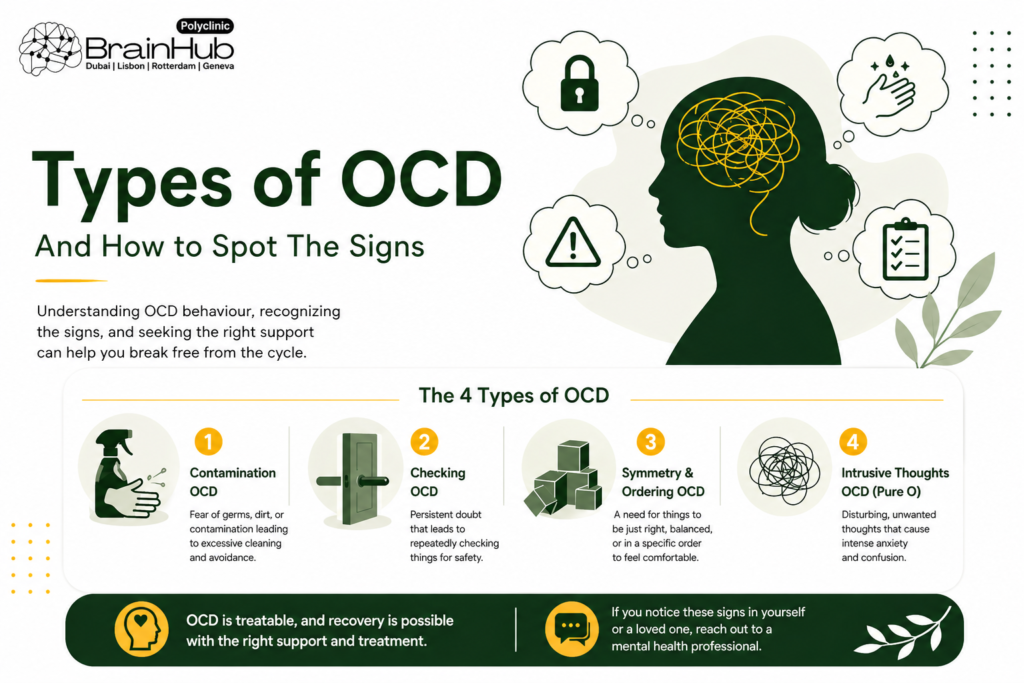
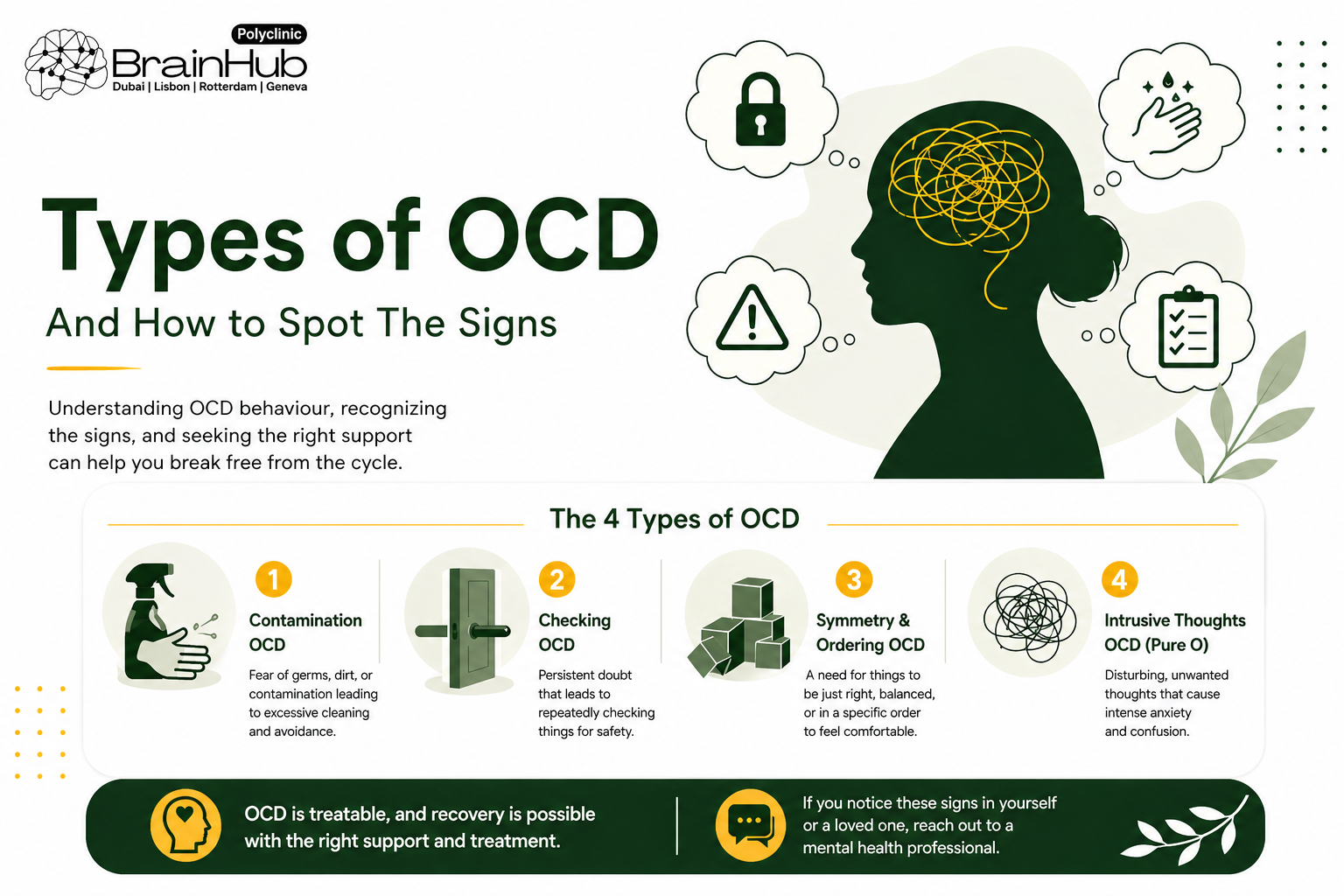
While OCD appears in many forms, understand what are the 4 types of OCD. As you read, notice what feels familiar; this can help answer “what kind of OCD do I have?”
Type 1: Contamination OCD – “What if I’m dirty, dangerous, or spreading harm?”
Imagine spending 45 minutes washing your hands before you can leave the bathroom. Not because you enjoy it, but because you feel that you may contaminate someone.
Contamination OCD goes far beyond hygiene preferences. The fear is relentless.
OCD intrusive thoughts in this type sound like:
- “What if there were germs on that surface and now I’ve infected my family?”
- “What if I’m morally contaminated after being near that person?”
- “What if touching that made me dangerous to others?”
Type 2: Checking OCD – “What if something goes wrong because I wasn’t careful enough?”
People with checking OCD live in a state of doubt – not because they’re careless but because their brain refuses to accept the certainty as real. The checking isn’t about being careful; it’s about trying to silence a fear that never fully goes away.
Checking OCD sounds like this:
“Did I leave the stove on? What if there’s a fire while I’m gone?”
“Did I say something offensive in that email? Let me read it again.”
“Did I accidentally hurt someone while driving? I need to go back and check the road.”
Type 3: Symmetry and ordering OCD – “It has to be right. I can’t explain it. It just has to be.”
A lot of people mistake this for perfectionism. But there’s a real difference between liking things neat and needing them to be a certain way just to feel okay. People with symmetry OCD aren’t being fussy; they’re trying to get rid of a discomfort that won’t go away until everything feels “just right.”
What it feels like:
- Rearranging items until they feel balanced, sometimes for 30 minutes at a time
- Tapping one side of the body because the other side was touched
- Repeating actions an exact number of times
- Feeling physically distressed when symmetry is disrupted
Type 4: Intrusive thoughts OCD (pure o) – “What does it mean that I had that thought?”
Pure O is probably the least talked about type of OCD. The thoughts are disturbing, unwanted, and feel completely unlike you. And because nothing visible is happening on the outside, most people suffer quietly, too afraid to tell anyone what’s going on in their head.
OCD intrusive thoughts examples in this type:
- A loving parent suddenly having an image of harming their child, and being horrified by it
- A deeply religious person experiencing repeated blasphemous thoughts during prayer
- A person in a committed relationship is being flooded with doubts about their love
- Someone fearing they might “snap” and do something violent, despite having no history or desire to do so
Many people experience a mix, which is why identifying types of OCD requires professional insight.
Related Blogs



Intrusive vs impulsive thoughts - They're not the same thing
Intrusive thought (OCD) | Impulsive thought | |
How it feels | Unwanted, shocking | Tempting, even if you know it’s not wise |
Your reaction | Horror, shame, distress | Urge to act on it |
What drives it | Anxiety | Impulse or craving |
Associated with | OCD | ADHD or a certain personality disorder |
How do you know if you have OCD? Signs most people miss
If you’re asking, “How do you know if you have OCD?”, the answer lies in patterns.
Common signs of OCD
Recognizing signs of OCD early can make a big difference:
- Persistent, unwanted thoughts
- Repetitive behaviors you feel compelled to do
- Anxiety when you try to resist
- Temporary relief after rituals
Signs of OCD in adults
The signs of OCD in adults often look like:
- Spending hours on rituals
- Difficulty focusing at work
- Strained relationships due to reassurance-seeking
- Awareness that behaviors are irrational, but feeling unable to stop
These are classic Obsessive Compulsive Disorder symptoms that shouldn’t be ignored.
Common OCD compulsions and what triggers them
Common OCD compulsions
Some of the most common OCD compulsions include:
- Repeated cleaning or handwashing
- Checking doors, locks, and appliances
- Counting or repeating phrases
- Arranging objects “perfectly.”
- Seeking constant reassurance
These behaviors are not habits; they’re attempts to manage anxiety caused by obsessions.
OCD triggers
Understanding your OCD triggers can help you manage symptoms more effectively.
Common OCD triggers include:
- Stressful life events
- Illness or fear of contamination
- Relationship uncertainty
- Major life transitions
At BrainHub UAE, identifying personal OCD triggers is a key step in treatment planning.
Is OCD an anxiety disorder?
OCD is closely related to anxiety but is classified as its own condition. Anxiety is a core part of OCD, but it falls under “Obsessive-Compulsive and Related Disorders.”
What kind of OCD do I have? Why does diagnosis matter?
Self-diagnosis can be a starting point for self-awareness, but it can’t replace professional evaluation.
At BrainHub, the diagnostic process includes a structured psychological interview, clinical observation, and access to advanced tools such as Quantitative EEG (qEEG) Brain Mapping, which maps specific neural activity patterns associated with OCD and informs a far more personalized treatment plan than symptom checklists alone can provide.
Best medication for OCD intrusive thoughts & treatment options
If intrusive thoughts are overwhelming, you may wonder about the best medication for OCD intrusive thoughts.
Medication
Common options include:
- SSRIs (first-line treatment)
- Other prescribed medications based on individual needs
Therapy
At BrainHub UAE, treatment focuses on long-term results:
- Cognitive Behavioral Therapy (CBT)
- Exposure and Response Prevention (ERP)
- Personalized therapy plans
The most effective approach often combines therapy with the best medication for OCD intrusive thoughts.
Neuromodulation – When standard treatments aren’t enough
For treatment-resistant OCD, BrainHub offers Transcranial Magnetic Stimulation (TMS) – an FDA-approved, non-invasive procedure that uses magnetic fields to calm the overactive brain circuits responsible for OCD.
Can you have OCD without compulsions?
Many people ask, can you have OCD without compulsions? The answer is yes.
Some individuals experience intrusive thoughts without visible behaviors. Instead, the compulsions happen mentally, like analyzing, repeating phrases, or trying to neutralize thoughts.
Because it’s not visible, this form of OCD often goes unnoticed, but it can be just as distressing.

What to expect at your first appointment at BrainHub UAE?
We know that reaching out is often the hardest part. Here’s what happens at BrainHub:
- A confidential conversation: You share what you feel comfortable sharing.
- A thorough assessment: clinical interview, behavioral history, and, where appropriate, cognitive and neurological profiling.
- Advanced diagnostics: qEEG Brain Mapping to understand what’s happening at a neurological level, not just a symptomatic one.
- A personalized plan: built around your specific OCD type, your life, your goals, and your pace.
- Ongoing support: symptom tracking, therapy sessions, medication review if needed, and a relapse-prevention toolkit for the long run.
You’ve already taken the first step by reading this. The next one is just a conversation.
👉 Book your confidential consultation at BrainHub today, because with the right support, manage OCD and get back the happiness in your life.